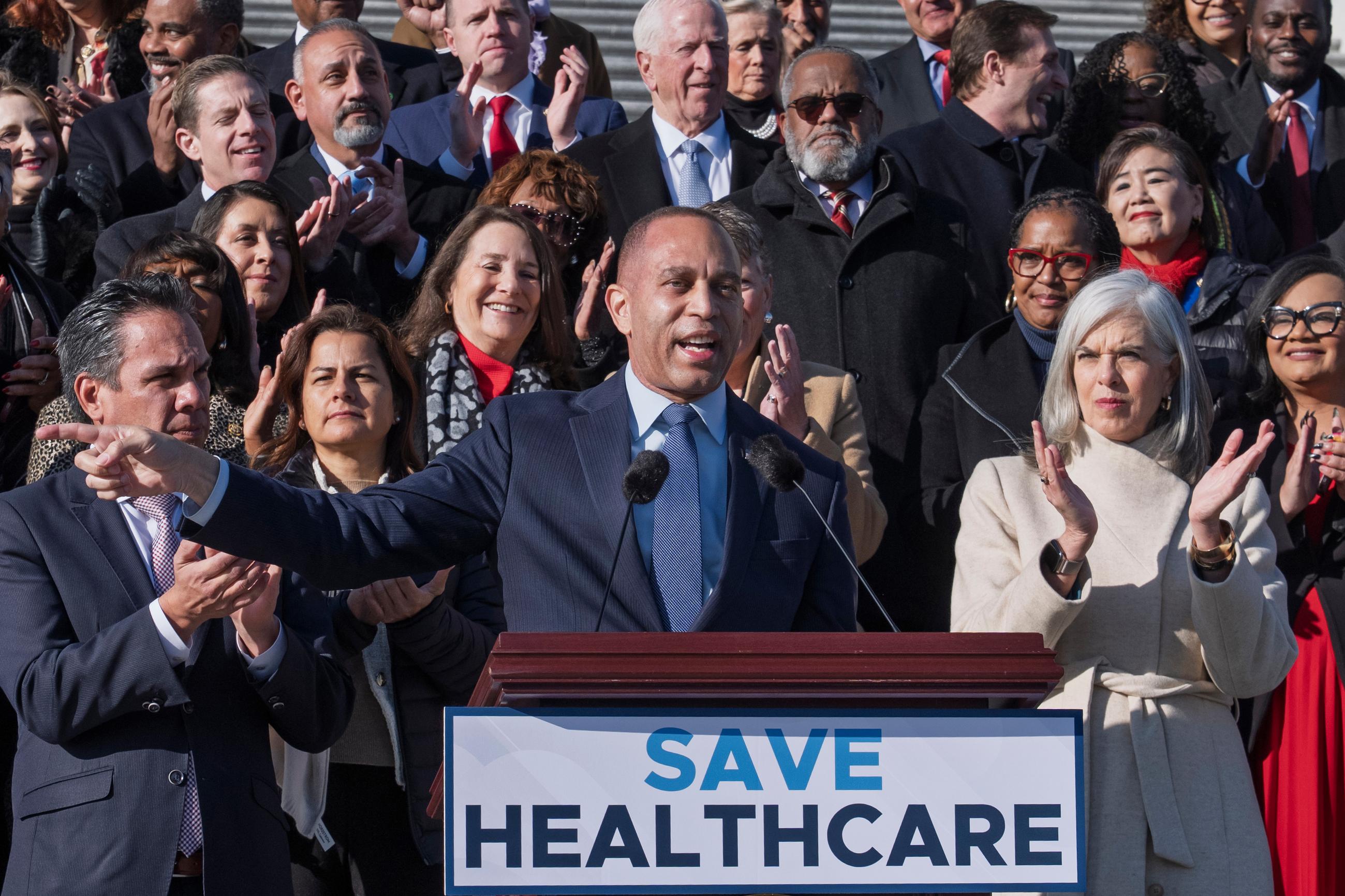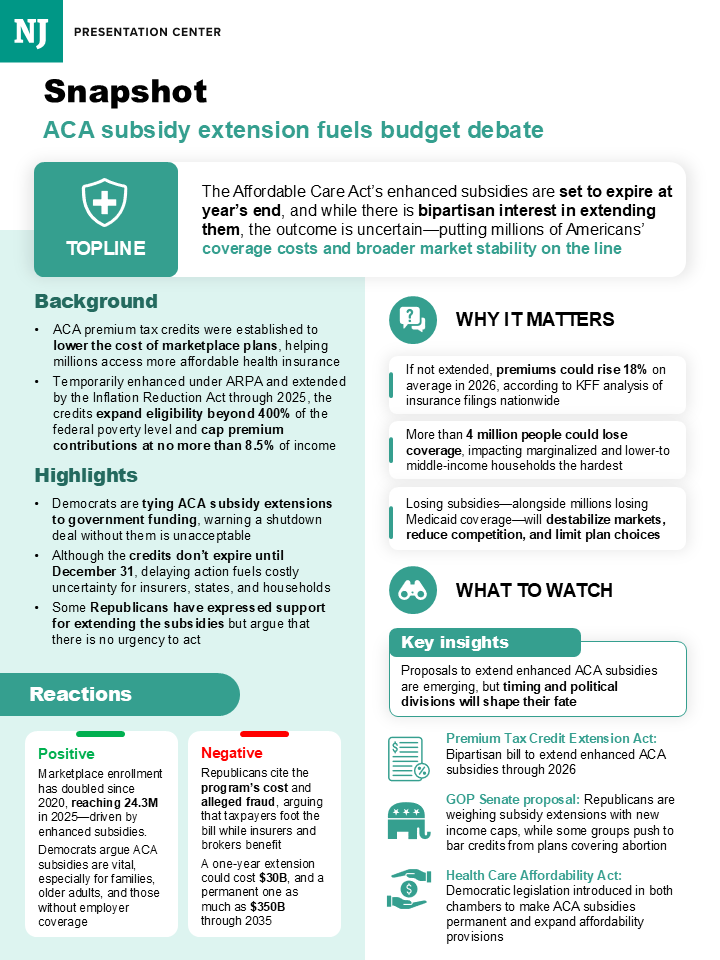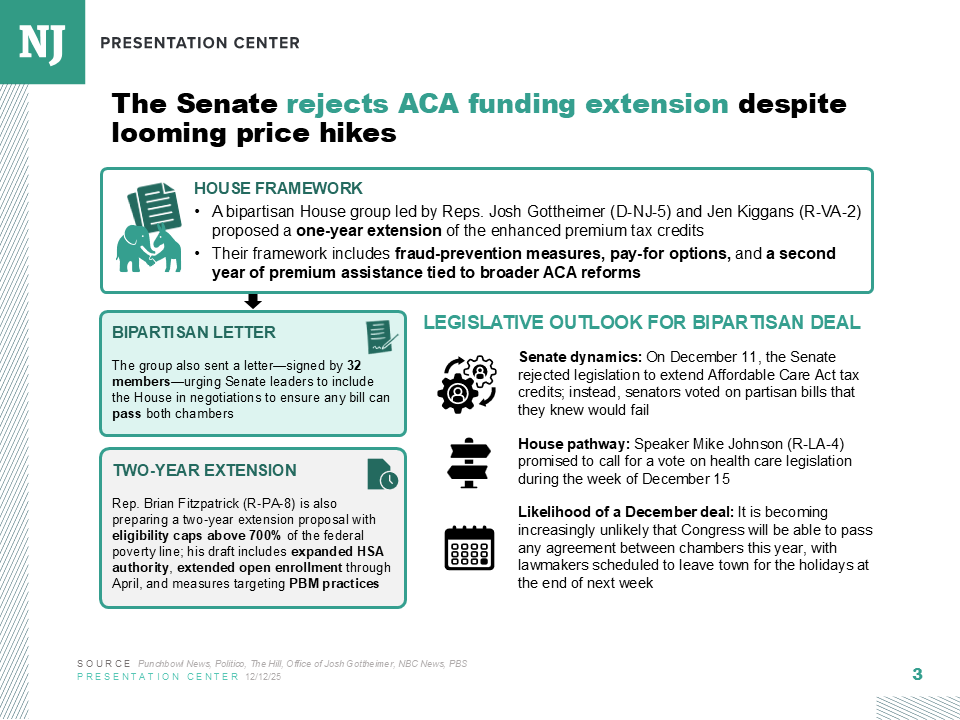


For the last year, lawmakers have tried a myriad of strategies to prevent the Affordable Care Act’s enhanced premium tax credits from expiring.
But floundering negotiations, disagreements between parties on the tenets of a possible deal, and fractures within the GOP on how to approach the politically lethal issue ultimately doomed negotiations.
The result: Enrollees on the marketplace saw premiums skyrocket when the subsidies expired in December, leading many ACA enrollees to drop their coverage.
Lawmakers had been making a quixotic attempt to try to reach an agreement extending the subsidies since the end of last summer. But it was never a simple negotiation of extending or not extending them: Republicans, who have railed against the ACA since its inception, were divided on the idea of breathing new life into a pricey—but popular—Democratic policy, and were pushing for more-conservative reforms. Democrats felt pressured by their base to stand up to the Trump administration—ultimately leading to the longest and most painful government shutdown in history.
Ultimately, neither side won—except the fiscal conservatives who had called for the enhanced subsidies to die since the beginning of the policy brawl.
“I think it's really unfortunate that millions of Americans are going to lose their health insurance,” said Sen. Jeanne Shaheen, one of the key Democratic negotiators on the issue.
The last stand
The final nail in the coffin came during the last two weeks. Senators had eyed the end of January as their self-imposed deadline for coming up with a bipartisan deal. Open enrollment for the ACA marketplace closed Jan. 15, and enacting broad reforms to the marketplace or subsidies would be more complicated the longer time dragged on.
But even after a month of focused negotiating—key players had dwindled down to a core, bipartisan group of senators who created a group chat to plan meetings and coordinate with one another—talks still fell flat. The issue of abortion language stood as the tallest—an ultimately unscalable—mountain to climb, as Republicans never budged on incorporating the Hyde amendment, which bans the use of federal funds for abortions.

Democrats asserted that the Hyde amendment was already in the ACA, but Republicans wanted language to go further than what was already in statute. Sen. Bernie Moreno, the head GOP negotiator, drafted language that he said marked a reasonable compromise, but Democrats claimed the draft went beyond what the group had agreed upon.
Democrats privately met Tuesday night, and intended to approach Moreno Wednesday with an ultimatum, according to Sen. Tim Kaine: Either take out the Hyde language, or conversations will end.
While it’s unclear if that meeting ultimately happened, there’s no evidence that Moreno took out the Hyde language.
Moreno’s office declined to comment. Moreno has also claimed that Minority Leader Chuck Schumer was squashing any chances of a deal coming together, arguing the Democratic leader wanted to play politics rather than reach a bipartisan policy outcome.
At least one House Republican took issue with GOP lawmakers inserting abortion into the talks.
“I don't know why they would bring abortion into every single piece of legislation,” said Rep. Brian Fitzpatrick, who bucked GOP leadership by joining Democrats to bring an ACA subsidy-extension measure to the floor. “It has no place in it.”
The Pennsylvania moderate didn’t mince words for the Republicans who wanted to add Hyde into the conversation: “They should get over it.”
Fitzpatrick, and three other House Republicans, had side-stepped leadership back in December to get a measure extending the subsidies for three years to the Senate. But with their hard-fought efforts dying in the upper chamber, National Journal asked if the fight with leadership was worth the headache if a deal had ultimately collapsed.
“I think it absolutely continued the conversation and showed our willingness to try to work together,” said Rep. Ryan Mackenzie, another Pennsylvania Republican who signed onto the discharge petition. “And ultimately, it may not be successful, but it wasn't for lack of trying on our part.”
There were other issues that kept lawmakers from a possible deal.
Democrats went back and forth with the GOP over proposals eliminating zero-dollar minimum premiums and reviving funding for cost-sharing reductions, which help reduce out-of-pocket health care costs. This language, they argued, threatened people’s coverage while also making the subsidies less generous.

The on-and-off nature of negotiations within the last month was emblematic of the larger deal-making effort over the last year: Conversations would pick up, then hit a wall. Rinse, and repeat.
Conversations on how to avert the impending expiration had started heating up at the tail end of summer. Lawmakers were privately having conversations on how to navigate the impending crisis, which led to skyrocketing premium costs and over a million people being kicked off the exchanges.
Moderate Republicans were worried that the issue could cost them their districts, and they were pleading with leadership to do something on the issue. But the conference was divided. Fiscal hawks were concerned with the hefty price tag of the subsidies and did not want to breathe further life into Obamacare—especially after Republicans had been able to enact their most successful “repeal and replace” effort against the ACA through the health care cuts in the “One Big Beautiful Bill.”
Some moderate Republicans have been calling for an extension for more than a year. Sen. Lisa Murkowski was one of the first GOP lawmakers to signal support for an extension, as early as January 2025.
A number of Democrats, however, lamented that Republicans came late to the discussion as the party waffled on how to approach an extension.
“We gave them every opportunity,” said Sen. Ron Wyden, the ranking member of the Senate Finance Committee, who said he constantly talks to Chair Mike Crapo. “I usually get flak for being too bipartisan in terms of health care. But they were talking about antiabortion principles from Day One, until Moreno basically put up a white flag of surrender.”
The issue came to a head in October, when the subsidies’ extension was at the heart of the shutdown—which ended only following the promise of a vote on the issue in December.

“The shutdown killed us,” said Senate Health, Education, Labor, and Pensions Committee Chair Bill Cassidy, another Republican involved in conversations. “More time would have helped, but the shutdown—which was not Republicans’ fault—was really difficult.”
Cassidy, however, took a shot at Health and Human Services Secretary Robert F. Kennedy Jr. on the issue of Hyde, arguing that the former Democrat's stance on abortion complicated considerations of how any bill might be enacted at the agency level.
“Part of the problem is, life groups don't trust Secretary Kennedy,” Cassidy said. “Their perception is that he's pro-choice and pursuing that agenda. So that made it more difficult on our side, knowing that it's already a difficult issue between the two parties."
The president had reportedly planned to wade into the conversations with a proposal to extend the subsidies, but he quickly backtracked on the issue.
Lawmakers say they are still optimistic they’ll find a path forward on lowering health costs as the issues of affordability and health care are set to collide in this year’s midterms. But bipartisanship, ultimately, is hard to find in an election year—especially when tensions are so high between both parties.
“So many people are going to suffer because of this, and I'm sad about it," said Rep. Tom Suozzi, a co-chair of the bipartisan Problem Solvers Caucus. "But we have to now figure out what other things we can do to try and reform health care and reduce the cost for people.”