
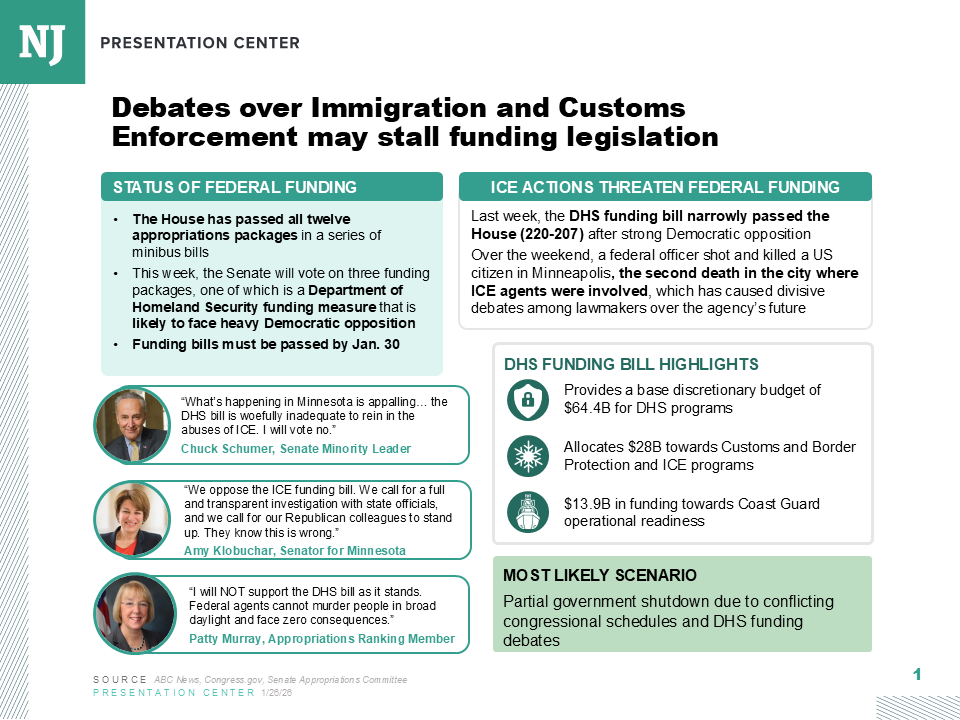
Congress voted to end the short federal shutdown Tuesday—but the real work begins now, with lawmakers chasing down an elusive immigration deal after the killings of two Minneapolis residents by federal agents ignited a national outcry.
President Trump signed the $1.2 trillion funding package into law shortly after it passed the House Tuesday afternoon. The measure allows for most of the federal government to be funded until Sept. 30, the end of the fiscal year. However, funding for the Homeland Security Department would continue at current levels for the next 10 days, following a deal between Senate Democrats and the White House to negotiate possible immigration-enforcement reforms. Much of the Democratic base has been demanding lawmakers withhold funding for Immigration and Customs Enforcement following the killings of Alex Pretti and Renée Good.
Even before formal negotiations have started, lawmakers are casting doubt that talks will yield fruit. Immigration reform is a charged issue for both parties, and lawmakers have tried—and failed—over the last three decades to pull meaningful reform past the finish line. And this time around, lawmakers only have a little over a week to perform a miracle.
“It’s a tight turnaround,” said Sen. Dick Durbin, the longest-serving Democratic whip, who has spent much of his career fighting for immigration reform. “We’re talking about four or five issues that we want to be doable.”
Another Senate Democrat was a bit more direct when asked if he was optimistic about any deal coming together: “No,” said Sen. Ruben Gallego before diving into a closing elevator.
But in a sign that conversations are beginning, Gallego confirmed to National Journal that he joined the Progressive Caucus’s meeting on Tuesday to discuss strategy ahead of upcoming negotiations over DHS funding. And several Republican senators have said that preliminary conversations are beginning ahead of the 10-day stretch—although many were waiting for the funding package to pass the House before starting formal talks.
According to Senate Majority Leader John Thune, negotiations will be primarily left between congressional Democrats and the White House, although Senate Republicans will be engaged on the issue.

But if lawmaker sentiment is any indicator of where negotiations will go, it seems like both sides are far apart on any agreement. House Democrats outlined their demands in a press conference Tuesday, with a number of their reform proposals mirroring the asks Senate Democrats detailed last week. Those demands include requiring ICE agents to wear body cameras and to go unmasked while on duty, expanding judicial-warrant requirements for federal officers, enacting investigations into officers facing allegations of abuse, and laying out clear guidance on the use of force.
A number of Republicans cast the Democratic demands as non-starters, throwing cold water on the idea that any deal can be reached in such a short matter of time.
“Dead on arrival,” said Sen. Eric Schmitt when asked if ending roving patrols would be up for negotiation. “It’s ridiculous.”
Republicans have their own ideas for immigration reform, which mainly aid the Trump administration’s aggressive crackdown on undocumented migrants.
Some of the loudest calls are coming from conservative hard-liners pushing the Senate to take up the SAVE Act. The measure, which passed the House last year, would amend the National Voter Registration Act of 1993 to require voters to provide documentation proving their citizenship. The partisan elections bill, however, won’t pass the 60-vote threshold in the upper chamber.
Reps. Anna Paulina Luna and Tim Burchett threatened to tank Tuesday’s vote advancing the funding bill if the SAVE Act was not included in the spending package. However, following a White House meeting Monday, Luna wrote on X that she was given assurances that the Senate would take up the bill using a procedural move called the “standing filibuster.” The procedure would bypass the 60-vote legislative threshold and force Democrats to hold the Senate floor for hours if they want to block the bill.
Thune—who wasn’t a part of the White House conversation—said he had made no commitment on the procedural move, telling reporters he was committed only to discussing the option with Senate Republicans before moving forward with anything.
Both Luna and Burchett voted to advance the package in a procedural vote Tuesday but ultimately voted against the package, which passed 217-214.
Sen. Lindsey Graham has called on the Senate to vote on legislation he’s introduced that would impose criminal penalties on state and local officials who don’t cooperate with the federal government’s enforcement of immigration policy—essentially “ending the practice of sanctuary cities once and for all,” according to a release from the senator’s office. Graham temporarily held up the funding package last week over his bill and said that he’s secured a vote at a future date.
Schmitt, who supports a crackdown on sanctuary cities as well, also wants to see increased penalties for illegal entry and reentry, additional protections for ICE agents, and “decertifying” activist groups that have catalyzed the anti-ICE protests.
In one potential sign of progress, Homeland Security Secretary Kristi Noem announced Monday that body cameras would be required of federal immigration agents in Minneapolis, and later will be distributed nationwide as funding becomes available.
But when asked if Senate Republicans would be willing to codify this into law, Thune said it will depend on the White House’s thinking on the issue.
“Because they’re already putting some of that stuff out there, whether or not they want to have that law or not, we’ll see,” Thune said. “We’ll have to have that conversation.”
Despite the larger showdown between lawmakers over DHS funding, a shutdown would have little effect on the operations of the administration’s immigration enforcement, as the relevant agencies got a boost in funding from the “One Big Beautiful Bill Act” passed last summer. Still, the shutdown did impact critical agencies such as the Federal Emergency Management Agency, which has been vital in aiding communities through the large snowstorm that swept across the East Coast over the last few weeks.

Democratic lawmakers are diving headfirst into talks with the hopes that changes can be passed into law in a bipartisan manner—despite the odds counting against them.
“I hope that the Republicans will come around to the kind of common-sense guardrails that the Democrats have been talking about,” said Sen. Mazie Hirono, who sits on the Senate Judiciary Border Security and Immigration Subcommittee.
Considering the short timeline, Thune has indicated the Senate will have to be “ready” for another stopgap funding measure for DHS come Feb. 13, when funding is expected to run out for the agency. But House Democrats drew a line Tuesday against another temporary funding measure for the agency if their demands weren’t met.
“Absent bold and meaningful change, there is no credible path forward with respect to the Department of Homeland Security funding bill on February 13,” House Minority Leader Hakeem Jeffries said in a written statement.
Meanwhile, in the Senate, another stopgap funding measure for DHS is also looking like a tough sell for Democrats. Twenty-three Democrats, along with independent Sen. Bernie Sanders, voted against the final funding package last week—a vote that could be reflected again in the next week.
“That would be difficult,” Durbin said. “This notion now that we're going to ask all Democratic senators to ignore the two-week deadline, I think is wrong. I think we’ve got to move forward with that deadline and view it as realistic.”