
As much of the 2026 cycle centers on lowering the cost of living, the challenge for three vulnerable governors is navigating treacherous legislative landscapes.
Arizona Gov. Katie Hobbs, Rhode Island Gov. Dan McKee, and South Dakota Gov. Larry Rhoden are each entering election-year legislative sessions pitching signature plans on affordability and reducing taxes, while facing legislatures that are politically, and in some cases personally, aligned against them.
“I do think they need legislative wins, but I do think that sometimes the posturing is sufficient," said Julia Hellwege, distinguished professor of the Chiesman Center for Democracy at the University of South Dakota. "Sometimes not winning and saying, ‘Oh, it's all the legislature's fault’ ... can backfire, but the most important thing is to show that they are offering proposals.”

A divided Copper State government
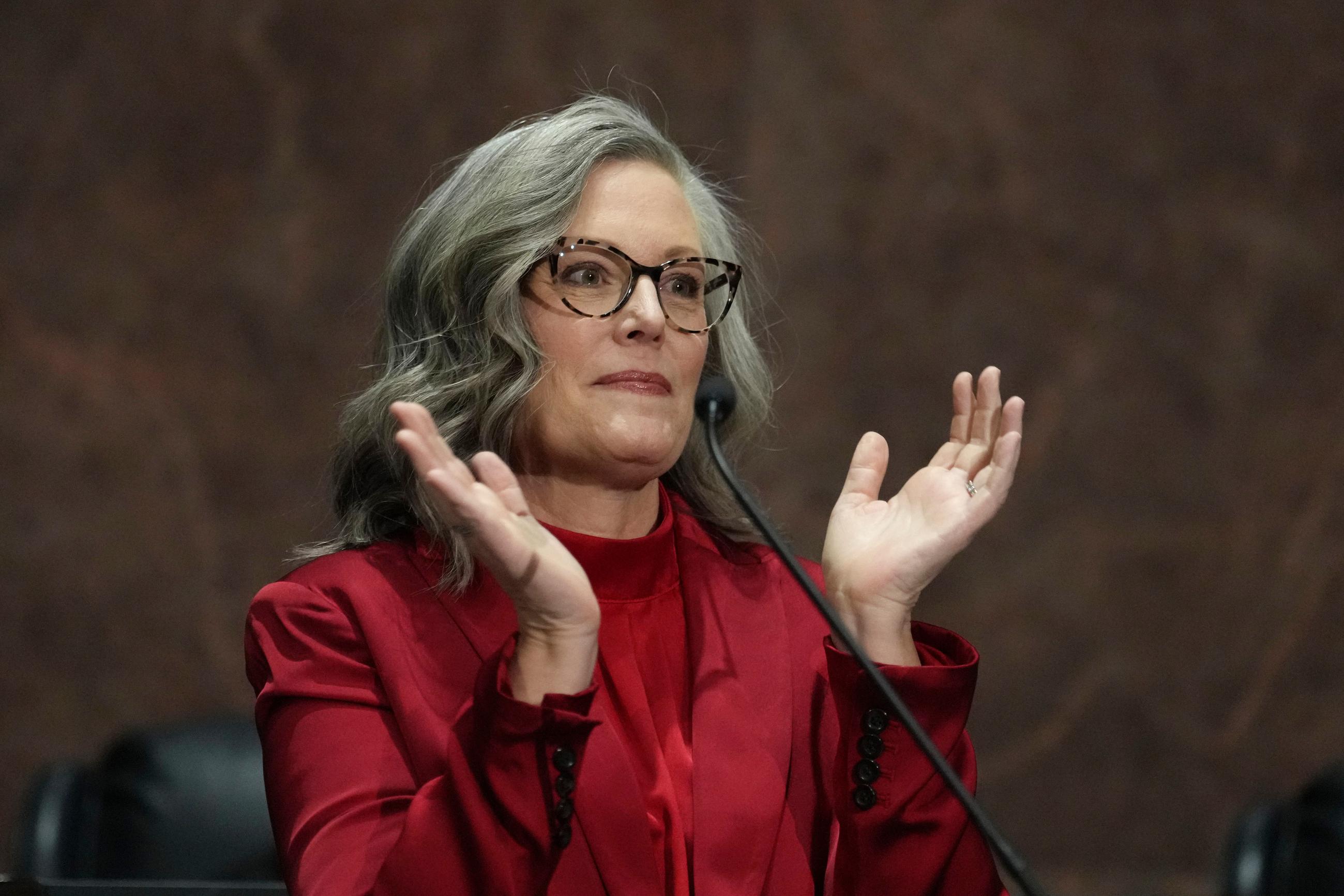
Hobbs, a Democrat narrowly elected in 2022, spent her first term as Arizona governor navigating an uncooperative GOP-controlled legislature. This session could be her toughest yet as she lays out her election-year affordability agenda to GOP lawmakers who are eager to make her a one-term governor.
In her State of the State address earlier this month, Hobbs proposed her Middle Class Tax Cuts Package, which mirrors the changes in the federal GOP reconciliation bill but doesn't include business tax breaks. She also proposed a data-center water-usage fee to fill the Colorado River Protection Fund, a short-term rental fee to finance the Arizona Affordability Fund, and additional aid for the Housing Acceleration Fund.
After three sessions of giving Hobbs little of what she’s asked for, Republicans are contesting whether her current proposals are “viable options,” Arizona GOP consultant Barrett Marson said. The legislative session, which adjourns in April, holds special importance for Hobbs, Marson added, “because she doesn't have that many legislative accomplishments to tout."
Hobbs broke the state’s veto record in a single legislative session twice, and has shot down 390 bills since taking office. She vetoed a GOP plan this month that would have applied President Trump’s One Big Beautiful Bill tax cuts to the Arizona state code, which clashed with her Middle Class Tax Cuts Package. Republicans said the plan would deliver $1.1 billion in tax relief over three years.
“Voters want to hear what you've done, not necessarily what you stopped from being done,” Marson said.
Adam Kinsey, a Democratic consultant with Uplift Campaigns, said Hobbs does have legislative wins, and he touted her executive actions, such as erasing over $600 million in medical debt last month.
Even if Hobbs has to compromise with the GOP-controlled legislature this session on her signature proposals, Kinsey added, it’s still a win for her. President Trump flipped the swing state in 2024 by 5.5 points on the same ballot where Democratic Sen. Ruben Gallego won by 2.5 points.
“The Democrats are seen as the ones who are willing to compromise. That is what the Arizona voters want, particularly the swing voters,” Kinsey said.
A wild card in Rhode Island’s state House
McKee, another Democrat, already faced an uphill battle to renomination before the start of this legislative session. His approval ratings have slipped, and voter frustration has deepened over his handling of the Washington Bridge closure, which isn’t expected to be resolved until 2028. Officials originally said structural problems discovered in 2023 could be repaired quickly, but part of the bridge was demolished, causing major traffic detours.
McKee faces a $101 million budget deficit, something he didn’t mention in his State of the State address. Instead, he pitched an “Affordability for All” agenda, which includes providing more than $151 million in ratepayer relief in 2027 on electric bills—over $1 billion in cumulative savings over the next five years—eliminating the state tax on Social Security, creating a child tax credit, and backfilling expired Affordable Care Act subsidies.
Without the power to line-item veto, he’ll need the Democratic-controlled legislature on his side to pass any of his proposals, an alliance that could prove to be difficult if state House Speaker Joe Shekarchi challenges McKee for the nomination, said Brown University political science professor Wendy Schiller.
If Shekarchi enters the race, he would be well-positioned to claim ownership of the affordability messaging McKee is now embracing, Schiller added. She noted that the speaker has led the effort addressing the housing crisis, unveiling a 12-bill legislative package in 2025 after proposing packages on housing in the last five legislative sessions.
“[Shekarchi] will have an advantage and be able to point to the things that he's already done that undermine the affordability messaging” of McKee, Schiller said.
Even if Shekarchi ultimately stays out of the race, McKee still faces a primary challenge from Helena Foulkes, whom he defeated by just 3 points in 2022. If Shekarchi opts not to run, he may instead strike an alliance with McKee—cooperating to advance legislation in a productive legislature to protect Shekarchi’s own political future, Schiller said.
A far-right fight in South Dakota
Rhoden enters his second legislative session as governor trying to prove he deserves a full term after ascending to the office following Homeland Security Secretary Kristi Noem’s departure. He’s doing so in a crowded GOP primary, and against legislative leadership opposed to his tax plan.
Rhoden must navigate a GOP-controlled state legislature which was taken over by a far-right faction two years ago, Hellwege noted. State House Speaker Jon Hansen sits at the center of that faction in the legislature, and he is running against Rhoden in the primary. Also running are Rep. Dusty Johnson and conservative activist Toby Doeden.
“So in many senses, things aren't looking great for Rhoden to get much of his legislative agenda through,” said Michael Card, an emeritus professor of political science at the University of South Dakota.
Taxes have emerged as a top issue in the legislature and the GOP primary. Hansen disagrees with Rhoden’s plan to allow counties to implement a local sales tax to fund residential property-tax deductions. A summer study group led by Hansen proposed 19 possible solutions to reduce property taxes, none of which Rhoden supported.
While he promoted his property-tax plan during his State of the State address, Rhoden may steer toward social issues during his campaign so as not to draw attention to tight budgetary concerns, Hellwege said. He secured conservative victories on a bill allowing concealed pistols in bars and on public college campuses, and banning the use of eminent domain to build carbon pipelines. Following the disruption of a religious ceremony in Minneapolis this month by protesters against the immigration crackdown there, Rhoden proposed a bill to upgrade any disruption of worship from a misdemeanor to a felony.
“The next big issue right now is property taxes. And so on the one hand, I think he wants to see movement on that and oversee movement on that,” Hellwege said. “On the other hand, I think budget issues can be challenging because a win for taxpayers and reducing their tax burden also consequently results in a reduced tax base.”