Jan. 27, 2026, 1:49 p.m.
PALM DESERT, Calif.—Is Rahm Emanuel, the former Democratic congressman, mayor of Chicago, White House chief of staff, and ambassador to Japan, ready for prime time as a national presidential candidate?
When he gave a paid presentation here Sunday evening to the International Dairy Foods Association’s Dairy Forum, Emanuel made some insightful observations on the state of the country and delivered a series of memorable one-liners, but his comments on food raised questions about whether he is sensitive to audiences who aren’t used to his brash Chicago style.
Asked by IDFA CEO Michael Dykes what will change the “very divisive time” the nation is experiencing, Emanuel said. “We didn’t get into this in one year, we won’t get out in one year. It will take a generation.”
Emanuel said there were “four peak moments that shattered” the country: the Iraq war that was “built on a lie”; the 2008 financial “meltdown” that was based on bad housing loans but exacerbated by bankers still wanting their bonuses; China’s decision that the United States is not a strategic competitor but a strategic adversary; and the COVID pandemic, when office workers got to work from the safety of their homes but “the rest” of the workforce was declared essential and had to go out into the world.
“At no time do the elite ever have a comeuppance” in these situations, Emanuel said.
Homeownership is “a point of the spear” in current politics because it is psychologically so important, he said.
When Dykes told Emanuel that his view seemed “gloomy,” he replied, “I didn’t say the American dream is dead. It has to be rekindled.”
The answer to rekindling the American dream is education, Emanuel said repeatedly. He took credit for improving the Chicago schools when he was mayor and mentioned his recent, much publicized trip to Mississippi to examine a successful education model based on phonics. Schools have to “get back to the fundamentals,” he said.
Emanuel said he reads a book every three weeks and the “one constant” in the history of American progress is education through institutions such as land-grant colleges and investments like the GI bill.
But he also said the U.S. needs to put more emphasis on training people for blue-collar jobs, because Ford has 7,000 jobs that “pay six figures” plus retirement benefits that the CEO can’t fill.
The way to bridge the urban-rural divide is to require all young Americans to participate in six months of national service, in which they meet their fellow Americans, he said.
He argued that while the White House comes with the bully pulpit, “right now we are leaning too much on the bully part, not the pulpit.”
Americans know more about President Trump’s position on windmills than on the fact that kids can’t read, Emanuel said. What’s worse, he added, the press isn’t asking about the issue and the governors are not asking for “an emergency meeting” to address it.
On immigration policy reform, he said, the solution would be for a president to get all the stakeholders into Blair House and reach an accord. But he added that this would take so much political capital it would be the last achievement of that president.
As for Health and Human Services Secretary Robert F. Kennedy Jr.’s pullback on vaccines, Emanuel said, “We are going to rue the day we have turned this over to a bunch of fools.”
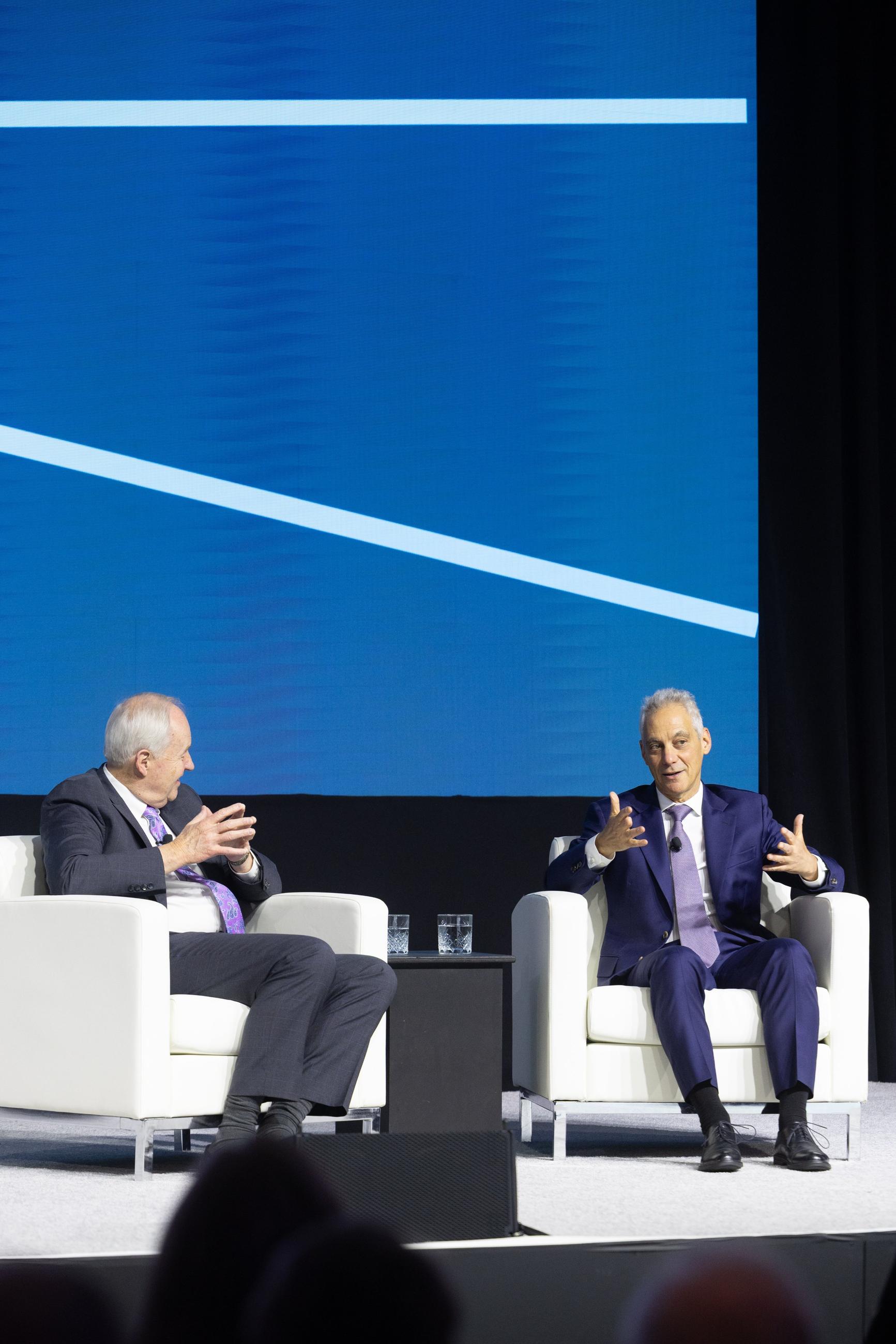
Emanuel chats with International Dairy Foods Association CEO Michael Dykes at the trade group's annual conference in Palm Desert, Calif., on Sunday.
(IDFA)
When Dykes asked Emanuel what kind of milk he prefers, he said, “I’m a skim-milk guy.” When the attendees, who are thrilled Congress just passed a bill to reverse an Obama-era policy that forbade full-fat milk in school meals, seemed disappointed, he responded, “I am just a skinny little Jewish kid; I am not going to make your profit margin.”
His favorite ice cream, he said, is rocky road: “I have a horrible sweet tooth.”
Emanuel said he hoped to have meat for dinner: “I have two vegans in the house. It is driving me crazy.”
After the event, one attendee wondered why Emanuel would tell a dairy audience that some of his family members are vegans. He has “some rough edges,” the attendee said. As he approaches a presidential run, the question may be whether the broader world appreciates his candor.