National Journal Logo
×

Welcome to National Journal!

Enjoy this premium "unlocked" content until February 28, 2026.

Continue

Trump’s ambassadors are largely political appointees

Fewer than 10 percent of the president’s nominees are career diplomats, a sharp departure from past practice.

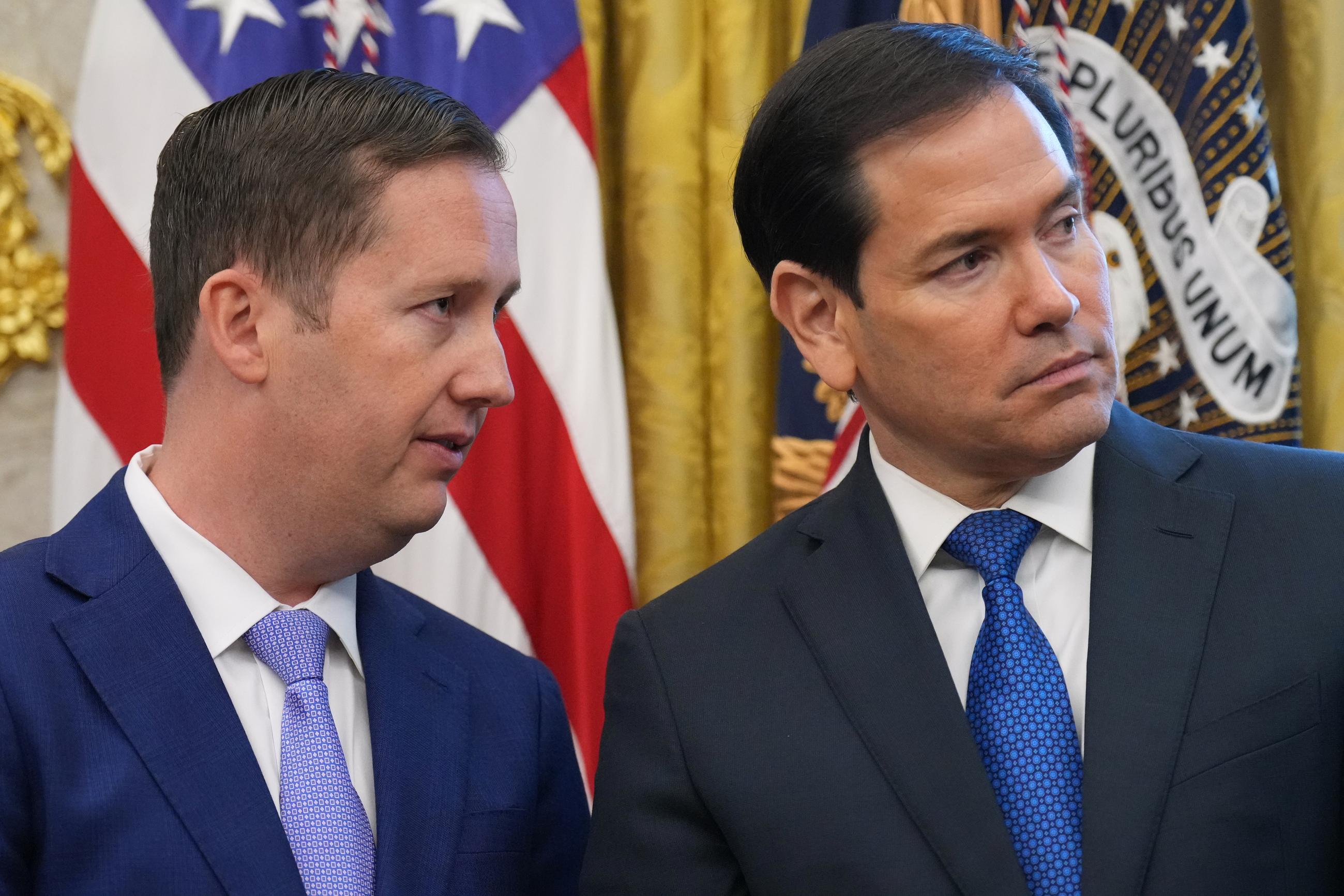
U.S. Ambassador to India Sergio Gor and Secretary of State Marco Rubio listen as President Trump speaks to reporters in the Oval Office on Nov. 10. (AP Photo/Jacquelyn Martin)
None

Want more stories like this?

Subscribe to our free Sunday Nightcap newsletter, a weekly check-in on the latest in politics & policy with Editor in Chief, Jeff Dufour.

Add to Briefcase
Ledyard King
Jan. 12, 2026, 5:49 p.m.

Even before the administration’s recall last month of nearly 30 career ambassadors from their posts across the globe, Donald Trump had already been refashioning the Foreign Service into an army of loyalists.

An ambassadorial corps in which the majority traditionally have been career diplomats has been anything but so far during Trump’s second term. As of Jan. 1, 64 of the 70 nominated ambassadors—91 percent—have been political choices, according to the American Foreign Service Association, the organization representing career workers in the State Department. That includes former football star Herschel Walker (The Bahamas), former Sen. David Perdue (China), and former Fox News personality Kimberly Guilfoyle (Greece).

During the entirety of Trump’s first term, 83 of his 191 ambassadors—or 43.5 percent—were political appointees, a number that was much more in line with past practice but still higher than the traditional 70/30 split between career and non-career diplomats.

As Trump’s second term nears the end of its first year, the trend is unmistakable—and dangerous, according to the president’s critics.

“Obviously, he has been waging a dizzying nonstop war on career diplomats since he showed up,” said Democratic Sen. Chris Murphy, a member of the Foreign Relations Committee. “He wants no one to work for him that does not facilitate his corruption. His foreign policy is fundamentally corrupt to the core, designed to enrich himself, his family, and his friends. And thus he can’t have any ambassadors that observe norms and rules. He has to have only ambassadors that will facilitate his personal enrichment.”

The transformation of the diplomatic corps comes amid a tumultuous moment in world affairs. Conflicts in Gaza and Ukraine drag on while Trump’s removal of Nicolás Maduro as president of Venezuela and threats against Cuba, Colombia, and Greenland exacerbate global tensions. Meanwhile, opponents of the regime in Iran are growing increasingly bold.

In remarks to the press last month, Secretary of State Marco Rubio defended the changes in how the administration is conducting foreign policy, including the dismantling of the U.S. Agency for International Development.

“We are changing this place so that it is our missions in the field that are not just driving directives from the top down but also ideas from the bottom up,” Rubio said. “And I’m very proud of that, and I think that’s going to lead and pay huge dividends for future secretaries of State long after I’m gone.”

‘The president’s prerogative’

Dennis Jett, a career diplomat who served as ambassador to Mozambique and Peru under the Clinton administration, said the proportion of political appointees under Trump is "outrageously high.” Jett told National Journal the president’s attempts to demolish the federal bureaucracy and the career diplomatic corps will make the fallout from the operation in Venezuela (where the U.S. has not had an ambassador since 2019) that much tougher to navigate.

“The Trump administration's effort to gut government and fire bureaucrats wholesale resulted in the decimation of offices in State, Homeland Security, and USAID whose job it was to deal with post-conflict stabilization,” said Jett, now an international-relations professor emeritus at Penn State University. “One would think the aftermath of the invasion of Iraq would have taught Washington politicians something, but apparently not. Good luck with sitting offshore and attempting to coerce Venezuela into letting the United States run the country.”

But Republicans who sit on the Foreign Relations Committee, which is responsible for vetting ambassadorial nominees, told National Journal the preponderance of political appointees does not trouble them.

“Under the Constitution, the president has the authority to nominate ambassadors. And the Senate has the responsibility to confirm them,” Sen. Ted Cruz said. “And that’s the president’s prerogative as the Framers of the constitution designed.”

Sen. Rick Scott said he’s hoping the Senate speeds up approvals for Trump’s ambassadors and other nominees that Democrats have tried to slow down.

"I think we ought to do the political ones. I think we ought to do the non-political ones,” Scott said. “Every president gets to decide what’s important to them. … Every president gets to do this.”

Friends, donors, and business associates

Jett divides typical political appointees into three categories.

“There were the ones who were campaign contributors, and that was about 40 percent of the political appointees. So it was purely a question of money,” he said. “And then there were friends of the president, college roommates, members of Skull and Bones [at Yale University], like George Bush. And then the third type, where you're giving a senator a job. … And now, of course, with Trump, if you're a member of Mar-a-Lago or another golf course, you’ve got a good chance, or if you're a business associate.”

Trump's roster of ambassadorial nominees include multimillion-dollar donors to the president and to GOP causes. Such nominees include Arkansas businessman Warren Stephens (the United Kingdom), Florida attorney Dan Newlin (Colombia), and Texas entrepreneur Melinda Hildebrand (Costa Rica).

Legislation introduced in 2024 sought to strengthen the requirement that political campaigns “not be a factor” in nominating ambassadors and mandate a presidential certification of compliance that “competence, rather than contributions to political campaigns, is the primary qualification for the appointment of an individual as a chief of mission.” The bill went nowhere.

Jett noted that most political appointees opt for Western Europe or the Caribbean, “somewhere where there's no threats to their health, no threats from terrorism or war, no threats from disease,” while career postings tend to be in less hospitable climates such as Central Asia.

‘A slap in the face’

Tibor Nagy, a veteran of Trump’s first-term State Department who served briefly last year as undersecretary for management, said he expects the ranks of political appointees to increase once the nearly 30 recalled career ambassadors return by the end of January. But he added that he doesn’t think it’s a cut-and-dried conclusion that political appointees are necessarily problematic as many Trump critics contend.

“When I was assistant secretary for Africa, I only had three political appointees among my 48 chiefs of mission, and two were purely political while one was an experienced long-term senior government official who I considered just as experienced as the career nominees," Nagy said. "So you might want to wait until we see how many new appointees are political versus career.”

But John Dinkelman, president of the American Foreign Service Association, which advocates on behalf of career diplomats and staff, said the administration’s push to install political appointees over career officers signals something darker.

It “seems to imply that career diplomats are not able to implement the policies of the president with the same fidelity, loyalty, efficacy, and granularity that a political functionary could, and that is a slap in the face of the very structure on which our diplomacy, and, frankly, our military and every other aspect of the intelligence community and generally the civil service is based,” said Dinkelman, who spent 37 years in several postings with the State Department.

“In some ways, what you're looking at here is a canary in the coal mine,” he told National Journal. “What is being done to the professional Foreign Service is a harbinger of what could be done to the rest of our government.”

Welcome to National Journal!

Enjoy this featured content until February 28, 2026. Interested in exploring more
content and tools available to members and subscribers?

×
×

Welcome to National Journal!

You are currently accessing National Journal from IP access. Please login to access this feature. If you have any questions, please contact your Dedicated Advisor.

Login