National Journal Logo
×

Welcome to National Journal!

Enjoy this premium "unlocked" content until February 28, 2026.

Continue

Q&A with Andy Beshear

The DGA chair lays out Democrats’ midterm road map.

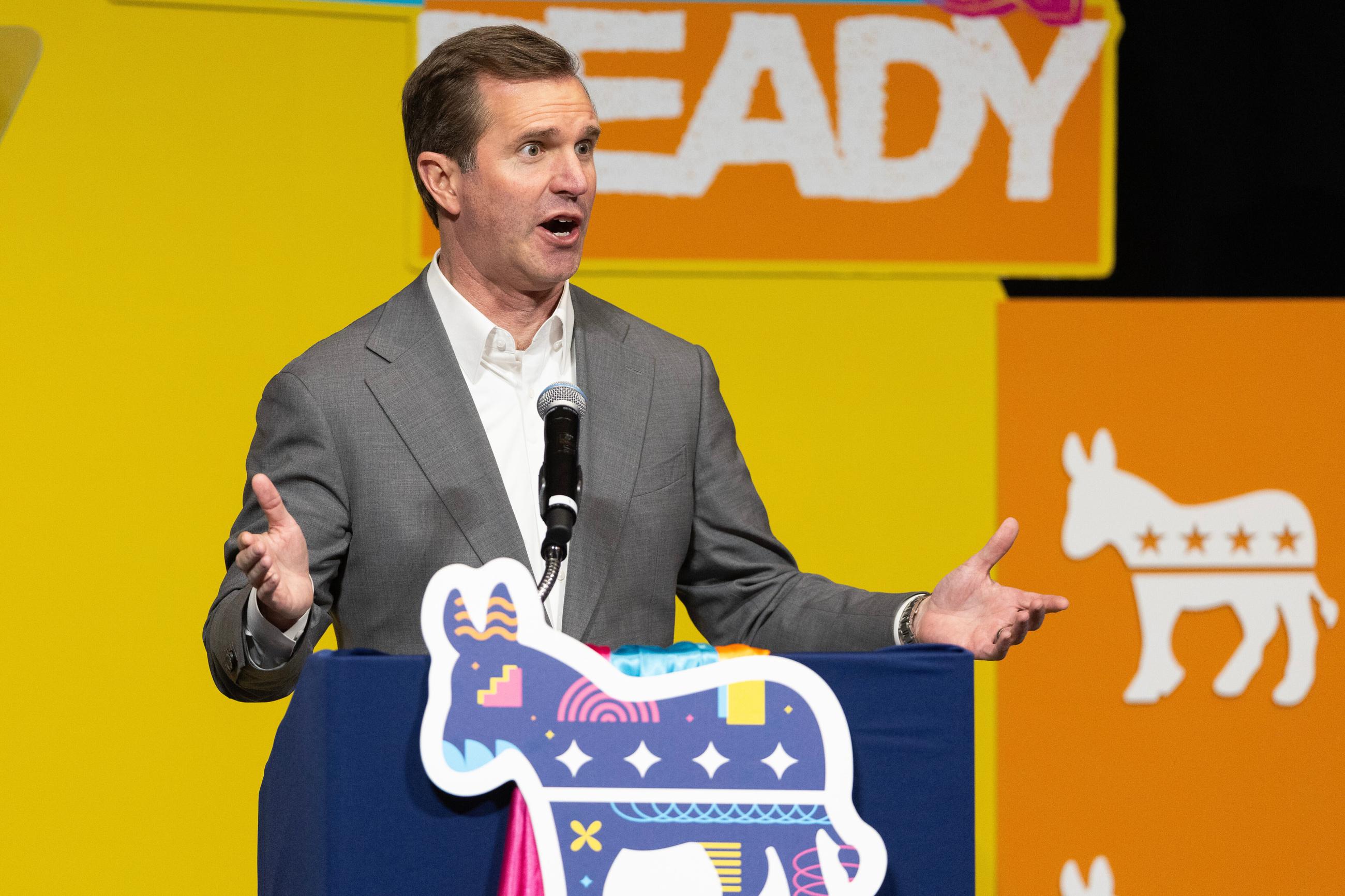
Kentucky Gov. Andy Beshear (AP Photo/Rebecca S. Gratz)
ASSOCIATED PRESS

Want more stories like this?

Subscribe to our free Sunday Nightcap newsletter, a weekly check-in on the latest in politics & policy with Editor in Chief, Jeff Dufour.

Dec. 8, 2025, 3:23 p.m.

PHOENIX—Kentucky Gov. Andy Beshear took the reins as chair of the Democratic Governors Association on Saturday. He will spearhead Democrats’ efforts to retain and flip governor’s seats in a midterm year with 36 states on the map. Beshear says he is confident his party will hold a majority of governor’s seats for the first time since the Obama administration.

Democrats hope Beshear’s experience winning in a red state will help the party make gains in similar areas during President Trump’s second term and navigate the increasingly tense relationship between the Democratic statewide executives and the White House.

His tenure leading the campaign arm comes on the heels of Democrats' double-digit sweeps in the Virginia and New Jersey gubernatorial races, and persistent chatter about his 2028 ambitions.

This interview has been edited for length and clarity.

How does your experience as governor of Kentucky prepare you to chair the DGA, and what would you do differently from the previous chair, Kansas Governor Laura Kelly?

I've had to win races in tough places. I'm in a Trump +30 state but won reelection by 5 percent, and have now won three straight elections in that state with a margin increasing each and every time. I think what it means is I know how to go into the reddest of red places, which is what the Democratic Party needs to do. We need to go to places that we haven't been in far too long, because what we're seeing right now is that those places, primarily rural America, are getting hit harder by Trump's policies than anywhere else. And with folks that are feeling betrayed, with folks that are being hurt, now's the time to try to rebuild trust and faith, and I think that's one way I can help lead this group. Now Laura Kelly went 2 for 2, which is pretty great, and both candidates, who are great candidates, won by big margins. Now, I don't think I can go 36 for 36, but we may try.

Are there any states that you see the DGA investing in during the midterms that might not have been seen as flippable or playable before?

I think you're going to see us certainly competing in Georgia and in Nevada, but I also think you're going to see us competing in places like Iowa. So I think that we have a number of places that people may think of as red states, but we're going to be there. But the other places we're going to be are places that people aren't expecting, where we have a really good candidate coming out of a great primary, and/or the other side puts up someone crazy.

After a disappointing 2024, how did Democrats bounce back in 2025?

Well, I believe that Democrats are winning right now for the same reason that Trump won last year. Now, last year, he was promising the American people that he would help them with their everyday lives—that people are struggling to pay the grocery bill and there's no way they can take their kids on that vacation that they could when they were kids, young couples can't afford that home anywhere near the age that their parents were able to, maybe even ever. That's what Donald Trump promised to do, but his policies are doing the exact opposite. Tariffs are raising the cost of everything from the hardwood floor to the cabinets to the upholstery, raising prices of groceries, making life that much harder. And then the big ugly bill is going to magnify that 10- to 20-fold, with rural hospitals closing all over America and devastating rural economies. So Democrats have the lane, and Abigail Spanberger and Mikie Sherrill drove right down it, of being there for the American people right now, restoring that American dream of making life just a little bit easier, a little bit better.

How do you think Democrats should approach voters who supported Trump in 2024?

Well, we can judge Trump, but we should never judge his voters. These are our friends and neighbors. They're certainly my friends and neighbors, and in the end, don't we want our McCarthyism moment where people breathe out and say, ‘OK, this went too far. We are not each other's enemies.’ A lot of these people we go to church with, and while Trump calls your neighbor the enemy from within, what does the Bible say? You're supposed to love them as yourself. And the parable of the Good Samaritan says everyone's your neighbor. And so I think for me, at least, I've got to live my faith and values and always be willing to welcome somebody back and engage with them, but that's the type of party the Democratic Party should be.

How do you think Democratic governors should go about balancing resisting Trump while also having to work with his administration?

Well, I don't think they're mutually exclusive. And to me, it's not personal. My job is to be the best governor I can for Kentucky. And so when the president does something that's positive, I'm going to say so. We had a pretty good response to the very first natural disaster when he was president, which was our February floods. And I said so nationally. He has a policy that's created a big investment in Paducah, it looks like. And I was there for the announcement. Why? Because a job in Democrat or Republican is just good for all our people. But then you look at his actions with SNAP—willing to use starving Americans as props—and I'm going to stand up to that each and every time.

What parts of your campaigning and governing style do you think Democratic candidates should emulate?

So you're asking me a political question. The answer, I think you'll find interesting, is we've got to recognize people aren't as political as we think they are. They don't wake up thinking about the 2026 elections. They wake up thinking about their job and whether they can support their family, the next doctor's appointment for themselves, their parents or their kids, the roads and bridges they drive each day, the school they drop their kids off at, and whether they feel safe in their community. With struggling American families, they want candidates and officeholders to be about their needs right now. Yes, we've got to build a future economy, but if we can be right there, if we can recognize that these things aren't partisan or even bipartisan ... they are nonpartisan, but it's our job to address them, then I think we continue winning.

Do you think the next president is at this annual meeting?

I think the next president should be a Democratic governor, and so if they're here, then yes—but I think for a couple of reasons. No. 1, look at the mess that Donald Trump has created with the federal government. Rebuilding it is going to have to take someone who has run a large operation, a leader that can bring other leaders along with them. I think a lot of Cabinet secretaries will need to be governors, too. Why? Because they can bring leaders from the state level to help replace some of the agency heads that have been lost with all the experience. But the other thing we need is someone who's less focused on the signing in the Rose Garden and more on getting the direct benefits of legislation to the American people as quickly as possible. And that's what, as governors, we have to do. We've got to get results.

What We're Following See More »

A sharply divided Federal Reserve cut interest rates by a quarter point, as widely expected, but with three dissents in opposite directions. Statement: www.federalreserve.gov/newsevents/p... Full coverage: www.nytimes.com/live/2025/12...

[image or embed]

— Ben Casselman (@bencasselman.bsky.social) December 10, 2025 at 2:01 PM

Welcome to National Journal!

Enjoy this featured content until February 28, 2026. Interested in exploring more
content and tools available to members and subscribers?

×
×

Welcome to National Journal!

You are currently accessing National Journal from IP access. Please login to access this feature. If you have any questions, please contact your Dedicated Advisor.

Login