For decades, governors have understood the numbers that mattered when trying to get Federal Emergency Management Agency aid for local disasters—damage-to-wealth ratios above at least 12.5, per capita damage indicators above $1.89, and benefit-cost ratios above 1.0. Now, under President Trump, they have learned that some new numbers count even more—30, the states he won in the 2024 election; 2,633, the counties in the Republican column; and 312, the electoral votes he turned red.
They are the president’s favorite numbers and his favorite topic, one he sounds almost as a mantra in formal speeches, off-the-cuff comments, and in 78 different Truth Social postings reviewed by National Journal since the Inauguration. The most recent example came on Thanksgiving Day, when he spoke to reporters at Mar-a-Lago. It was just a day after an assailant shot two National Guardsmen from West Virginia on the streets of Washington, fatally wounding one.
Asked if he would attend the funeral of Army Spc. Sarah Beckstrom, 20, the president went right to the subject of the election: “I haven't thought about it yet, but it certainly is something I could conceive of. I love West Virginia. You know, I won West Virginia by one of the biggest margins of any president anywhere.”
It was a jarring, but not surprising, response by this president.
Most of his incantations of his electoral numbers, while out of step with even the most politically brazen of his predecessors in the Oval Office, are tangential and inconsequential. When they factor into decisions on helping those affected by floods, fires, and storms, though, the impact is both immediate and acute.
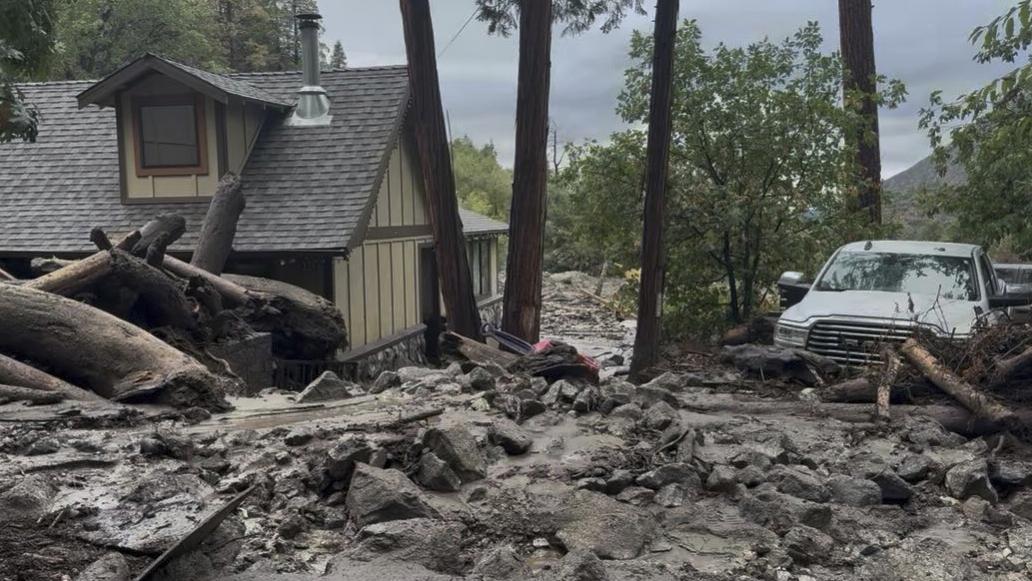
With only a few exceptions, Democratic governors who oppose the president and states which voted against him last year are seeing requests for federal disaster assistance rejected despite meeting standards that would have easily assured approval from past presidents of both parties. And they are watching the president openly link his decisions to the election.
Trump has used Truth Social to announce his decision to grant federal assistance to 14 states. In eight of those, he linked the decision to his own electoral success in the state. Almost always, the posting followed a similar formula:
- “…I am approving $25 Million Dollars to help Alaska.... It is my Honor to deliver for the Great State of Alaska, which I won BIG in 2016, 2020, and 2024—ALASKA, I WILL NEVER LET YOU DOWN!” (Oct. 22)
- “I just spoke with Governor Mike Kehoe, of the Great State of Missouri, and told him that I am approving $2.5 Million Dollars.... I won ‘The Show Me State’ three times in 2016, 2020, and 2024, and it is my Honor to deliver for these incredible Patriots!” (Oct. 22).
- “I just informed Senator Ron Johnson that, based on his request, I am approving $29.8 Million Dollars for the wonderful State of Wisconsin.... We had Huge Victories in Wisconsin in 2016, 2020, and 2024, and it is my Honor to deliver BIG for Wisconsinites!” (Sept. 11)
- “I just got off the phone with our wonderful Republican Leader John Thune. I am approving over $500,000.... I love the people of South Dakota, who voted for me in Historic Margins in 2016, 2020, and 2024.” (Sept. 11)
At the same time, he has delivered bad news to blue states such as California, Illinois, Vermont, and Maryland despite what outside observers considered compelling demonstrations of damage from flooding and storms and strong cases for federal help. On one day, Oct. 22, Trump approved disaster declarations for Alaska, Nebraska, North Dakota, and the Leech Lake Band of Ojibwe, but turned down requests from Vermont, Illinois, and Maryland. It was Maryland's second request for help cleaning up the damage from May flooding that devastated the state's two westernmost counties—ironically, counties that had supported Trump. Gov. Wes Moore called the denial "deeply frustrating." Illinois Gov. J.B. Pritzker, who Trump called a "fat slob" the week he submitted the disaster request, has appealed the refusal. He requested $130 million to help those whose homes were damaged by rainstorms in July and August.
“Trump’s approach is completely unprecedented,” said Kenny Stancil, senior researcher at the Revolving Door Project, a progressive group that keeps tabs on the executive branch and has published a comprehensive tracking of all the disaster requests. “With Trump, there seems to be a clear streak of vengeance in some of these decisions.” Stancil added that the rejections were particularly unusual “because of the scale of destruction that was documented by FEMA.”
The White House staunchly defends the rejection of requests from Democratic states and denies that politics played any role. “Gone are the days of rubber-stamping FEMA recommendations,” said deputy White House press secretary Abigail Jackson, adding, “There is no politicization to the president’s decisions on disaster relief, unlike under the Biden administration, where FEMA officials refused aid to disaster survivors who displayed political signs and flags they disagreed with.”
That was a reference to an incident last November when a FEMA worker was fired after she told a team working with hurricane survivors to avoid homes with Trump signs. A later investigation found “no evidence” of any larger FEMA involvement in her act.
The president’s fixation on his election wins is far broader than disaster response. It dates back to his first full day in office in 2017. In a visit to the CIA that he called his first official stop, he turned to the election at the start. “We were unbelievably successful in the election with getting the vote of the military. And probably almost everybody in this room voted for me,” he said.
More recently, when addressing generals and admirals at the Marine Corps base in Quantico, Virginia, in September, he boasted, “We've got the highest numbers ever received in terms of districts. They have it broken up, 2,500 versus 525. We won every swing state. We won the popular vote. We won everything.”
In his commencement address at West Point in May, he again mentioned his favorite election stats.
In his current term, his wins rarely go unmentioned on Truth Social. On his seventh day back in office, he mentioned Nevada, “a State I love and WON BIG in 2024.” Last Tuesday, his 311th day in office, it was Nebraska in the spotlight: “The Cornhusker State, a place I love, and WON BIG six times, including Primaries, in 2016, 2020, and 2024!”
In between, the refrain has been non-stop—his “massive landslides” in Kentucky; “the most votes ever gotten” in Indiana; “the most Votes in History, BY FAR!” in Texas; “the Highest Number of Votes for any Office in the History” of Missouri. Of the 30 states he won last year, 22 have received mentions on Truth Social, some repeatedly—Florida and Texas seven times each; North Carolina, six; and Kentucky and Iowa four times each.
His vote-bragging intruded in actions usually separate from politics. On Aug. 22, when announcing a judicial nomination, he noted that the nominee is from North Carolina, “a State I love and won BIG in 2016, 2020, and 2024.” On Aug. 12, his wins were cited in reference to another judicial nominee from Alabama. On March 7, when nominating his ambassador to Kuwait, he cited the nominee’s work “to help us secure a Historic Victory in Michigan.”
In May, announcing he would give the commencement address at the University of Alabama, he noted, “I won the State by 45 points.” (It actually was 30 points.)
Even when he lost a state, the president has been willing to drill down to find good news. On May 27, he bragged he had won Maine’s 2nd congressional district “BIG” because of “the wonderful Lumberjacks who voted for me in great numbers.”
Those are the numbers that sustain the president, even if they are not always great for flood victims.