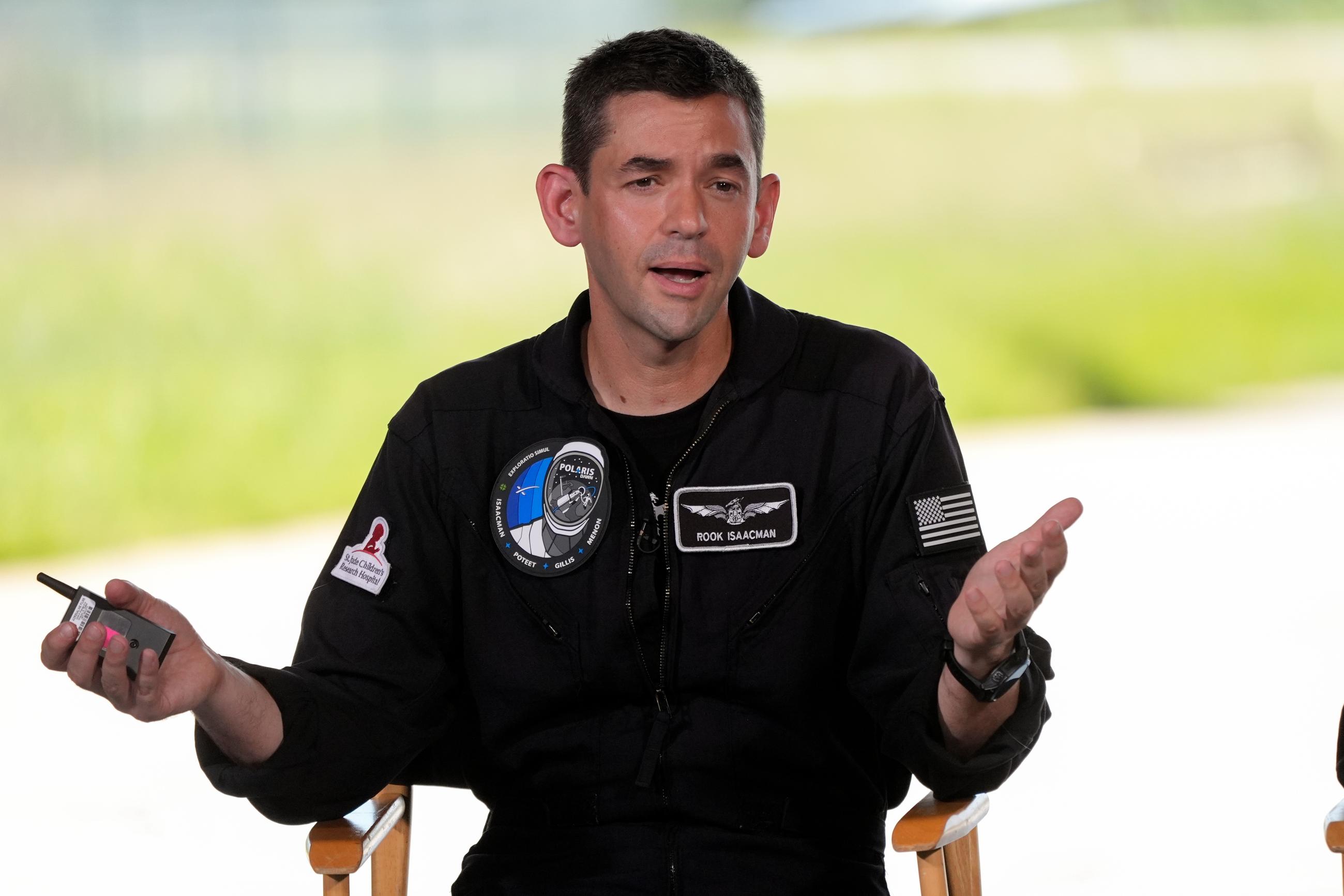
NASA is about to relaunch a mission that the White House abruptly aborted several months ago.
Not a rocket nor a satellite, but the nomination of Jared Isaacman as the head of the space agency, which has lacked a permanent administrator since January.
Donald Trump pulled Isaacman’s nomination in May, following the president’s messy fallout with SpaceX CEO and erstwhile Department of Government Efficiency head Elon Musk. The reemergence of Isaacman, a Musk ally, coincides with the repair of the relationship between Trump and self-described “first buddy” Musk.
Senate Commerce, Science, and Transportation Committee Chairman Ted Cruz described Isaacman as “terrific” to National Journal recently, indicating most systems are go when Isaacman appears before the panel Wednesday for a second hearing. The panel voted 19-9 in April to send him to the full Senate. Cruz predicts a quick confirmation this time and a vote on the floor within a week.
But confirmation seems the easy part. As administrator, Isaacman will have to deal with an agency reeling from massive layoffs, budget cuts, and growing pressure to return astronauts to the lunar surface before China does. At the same time, the agency’s ability to expand its scientific missions is being compromised by a brain drain accelerated by the layoffs.
“I'm anxious for his leadership, his personal leadership, but I'm anxious as well to get the position filled," GOP Sen. Jerry Moran, who chairs Commerce’s Aviation, Space, and Innovation Subcommittee, told National Journal. "We need leadership at NASA. We need full-time leadership. NASA faces lots of challenges. The country faces lots of challenges, and I'm anxious for his confirmation.”
Much of the space community is breathing a collective sigh of relief that Isaacman is back in play and that the agency won’t have to rely on Transportation Secretary Sean Duffy to keep moonlighting as NASA administrator.
A dynamic choice
A tech entrepreneur and commercial astronaut who has never worked for the government, Isaacman, 42, is seen by many as a dynamic choice who reflects the out-of-the-box thinking required for a rapidly evolving sector: someone who hails from the commercial side of the industry where most of the innovation is taking place.
Supporters also see him as an advocate for human space exploration and expanded scientific inquiry both in space and on Earth, an important counterweight in an administration determined to slash government spending, led by a president who denies climate change.
Scott Pace, director of the Space Policy Institute at George Washington University, sees Isaacman as “somebody who is fairly technical, certainly has space experience, [and] has dealt with federal acquisition rules in his defense side business."
"So he has fairly real-world experiences," Pace said. "And I think that that's important, because the problem right now is really program execution, implementation. It's not big policy. … Isaacman has the right skill set needed to do that.”
If Isaacman chafed at his on-again, off-again status, he never shared it publicly.
In a post on X last month shortly after Trump renominated him, the NASA nominee sounded grateful and optimistic about his new mission: “To the innovators building the orbital economy, to the scientists pursuing breakthrough discoveries and to dreamers across the world eager for a return to the Moon and the grand journey beyond—these are the most exciting times since the dawn of the space age—and I truly believe the future we have all been waiting for will soon become reality.”
Programs, not policy
Pace, who served as executive secretary of the National Space Council during Trump’s first term, said one of Isaacman’s biggest challenges is making programmatic decisions on how best to return astronauts to the moon under the Artemis Program.
“The geopolitical reason for going back to the moon, and in a sustainable way, is, of course, to shape norms of behavior and rules and the international partnerships and so forth for operating in cislunar space,” he said. “Now, to do that, you need to have a system that can get back to the moon in a repeatable way. The [Space Launch System] falls short. Set aside the cost issue. It simply doesn't fly enough to have the kind of repeatability we need. We need more and different options for getting to the moon.”
Pace ticked off some of the entrepreneurial models being developed—SpaceX’s Starship, Blue Origin’s New Glenn rocket, and United Launch Alliance’s Vulcan Centaur upper stage vehicle—as options NASA’s next administrator will need to consider as part of a sustainable lunar presence.
Isaacman will not have much time to get comfortable. China has ramped up its lunar missions, laser-focused on landing its astronauts, called taikonauts, by the end of the decade. It’s a race Trump’s first NASA administrator, Jim Bridenstine, fears China will win. Bridenstine told Cruz’s committee in September that the lack of a viable lunar lander makes it “highly unlikely” U.S. astronauts will beat the Chinese.
Bridenstine, the architect of the Artemis mission, who is now managing partner of a private group pushing for the mission, said the “complicated architecture” of the lander still requires at least a dozen more launches, relies on “very challenging technologies that have yet to be developed, like cryogenic in-space refueling,” and still must be certified to carry humans safely.
A bumpy confirmation hearing?
Anxiety over China’s advances figures to be part of Wednesday’s hearing, as do other challenges the space agency faces: the future of the International Space Station, the ability to carry out NASA's missions—especially around Earth science—with a smaller workforce, and balancing the growing complexity of the commercial space sector with NASA’s traditional roles.
Isaacman is also likely to be pressed about Athena, his 62-page vision for the space program which calls for “maximizing the orbital economy” and a reorganization “to liberate the NASA budget from dated infrastructure that is in disrepair to free up resources to invest in what is needed for the mission of the day.”
The draft document, leaked before it was ready for public presentation, rankled some in the space community who view it as a blueprint to do away with the SLS and the Gateway project designed to help astronauts ferry back and forth to the lunar surface—a claim Isaacman denies.
“This plan never favored any one vendor, never recommended closing centers, or directed the cancellation of programs before objectives were achieved,” he wrote on X after the document was leaked. “The plan valued human exploration as much as scientific discovery.”
Jack Kiraly, director of government relations at the Planetary Society, says he expects the confirmation hearing will offer senators a chance to vent on pet projects and specific issues but doesn’t think it will end up stopping Isaacman’s nomination from moving forward.
“It's certainly not going to be as smooth as I think the first confirmation hearing was [in April], which did kind of lack some of the deeper, finer details that folks might have on Wednesday," Kiraly said. "So we'll see. But we're also in a different political climate, and I think there is a lot of momentum behind Jared.”
Duffy’s timely arrival
That change in political climate is due in large measure to Duffy and his influence with Trump as a trusted member of the Cabinet, both Kiraly and Pace said.
Before Duffy absorbed NASA into his portfolio, the agency was facing deep cuts and uncertainty due to a lack of support in the White House. When Duffy took over, having no space experience, Kiraly said there was natural “consternation” that the space program would suffer.
Instead, Duffy held firm against many of those spending cuts, preserving key deep space missions such as VIPER (exploring the moon’s south pole) and OSIRIS-APEX (an asteroid mission). The Transportation secretary rebooted commercial programs as well, and is promoting a bold plan to launch a nuclear power plant to the lunar surface by 2030, a key component to lunar sustainability.
Trump' s initial 2026 budget proposal would have slashed the budget from $24.8 billion to $18.8 billion, with much of that cut coming out of the science budget. House and Senate appropriations bills have it at $25 billion, which Duffy has essentially blessed. In addition, the Big Beautiful Bill passed in June added a one-shot boost of $10 billion for NASA, much of it for the Artemis program.
“There’ll certainly be some cuts," Pace said. "There’ll certainly be some painful things going on. But I think somebody like Duffy, who is very close and part of the president's center, performed a very important role in stabilizing NASA through that period.
“The [six-month] time loss, while not welcome, did do a couple of things,” Pace added. “It allowed Duffy to score a couple of goals, demonstrate the value of someone who's close to the president. And it showed, again, maybe unintentionally, just what a gracious and professional and thoughtful person Isaacman is. I thought he was the right guy for the right job at the beginning. I continue to think that, even more so now.”