
WOODLAND, Calif.—While Washington dithers over a farm bill and immigration reform, farmers gathered here this week to see driverless tractors and agricultural robots and talk about the practicalities of buying the equipment to replace expensive, increasingly hard-to-get farmworkers.
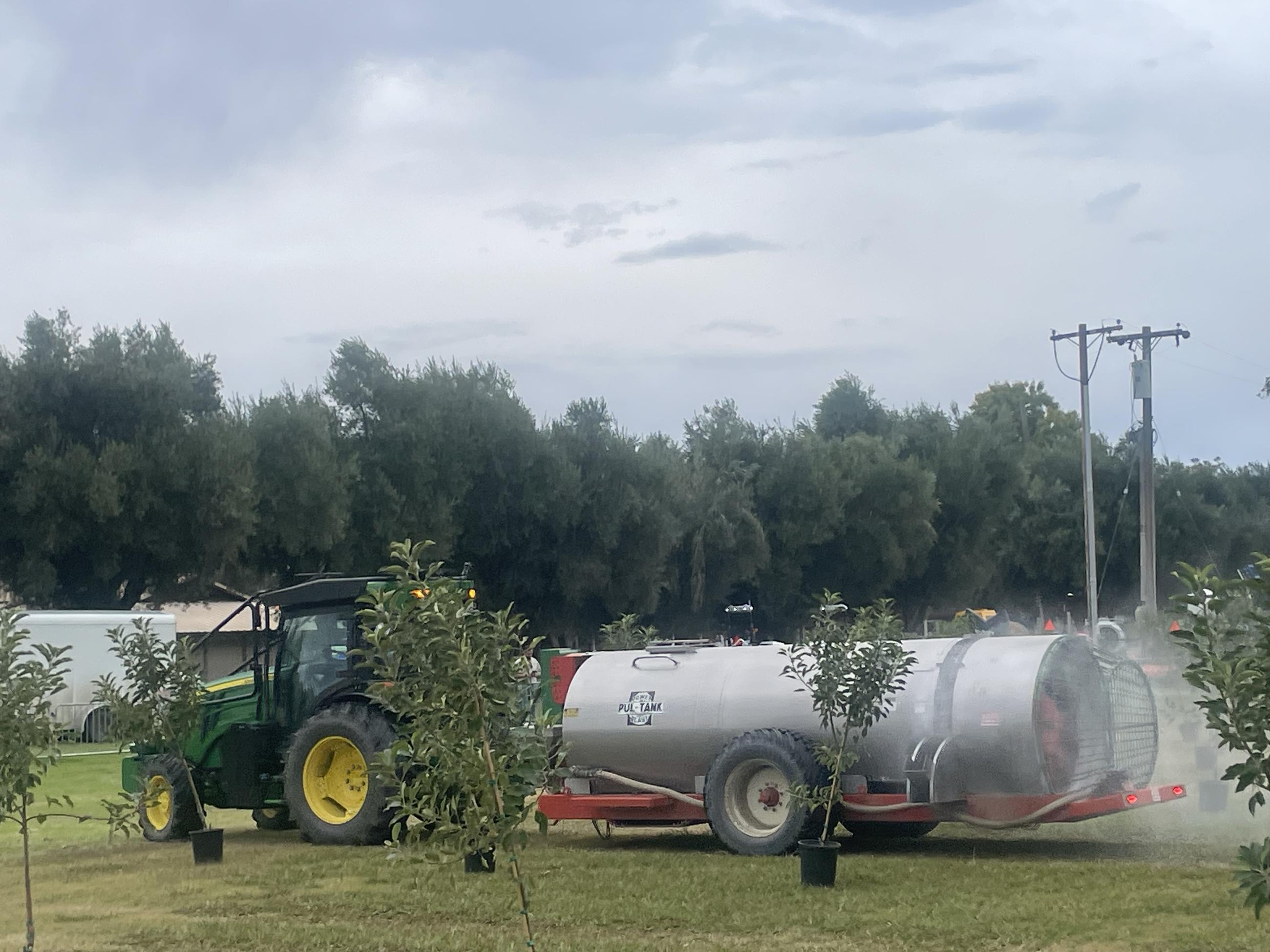
At the Yolo County fairgrounds, where a 1926 McCormick-Deering tractor on display celebrates the importance of machinery to the development of California agriculture, the FIRA USA 2025 agricultural-technology show featured driverless tractors, robotic seeders and sprayers, and drones that can keep birds away from berry and lettuce fields. Growers were admitted free to the show in an attempt to encourage them to buy into the future.
Buying a driverless tractor for more than $1 million or sprayers and weeders that can cost hundreds of thousands of dollars may seem impractical, especially given the low prices and high production costs that farmers are facing. But they may make sense for California’s specialty crop growers, according to Walt Duflock, vice president of innovation at Western Growers, an organization of fruit and vegetable growers in California and other Western states that was one of the sponsors of the convention.
With imported workers under the H-2A program costing $30 per hour, buying driverless machinery already makes sense for the biggest growers, Duflock said in an interview.
The show, organized by a French organization called FIRA, which describes itself as The Ag Robotics Forum, seems remote from federal policymaking. But Duflock said federal aid is needed because while private companies are developing autonomous equipment for planting, weeding, and spraying, attracting venture capital for harvesting equipment has proven impossible. (He added that an overlooked impact of low farm profits is that farm-equipment sales have gone down and the big companies that make it have cut back on buying tech startups. Such startups are too small to go public on their own, so they need the big companies to take them to scale.)
Harvesting machines must be specialized for each crop, and the market potential for each one is too small to be attractive to investors. Duflock said he is working with the Foundation for Food & Agriculture Research, a Washington-based public-private organization that uses federal money to leverage private funds for agricultural research, as well as the Agriculture Department’s National Institute of Food and Agriculture, to undertake the initial research on harvesting equipment.
The relationship between ag tech and farmers is intricate, said Duflock, who grew up in a California ranching and farming family. He spent years working in Silicon Valley before combining his backgrounds in agriculture and tech into his current position. There are a lot of ag tech ideas out there, Duflock said, but farmers won’t try them until they have some proof that they will work. At one FIRA session, an entrepreneur said he has to “overinvest” in “spare” equipment, because farmers get really angry if a weeding or seeding machine breaks down just when it’s needed to save a crop.
Ag tech is attractive for specialty crops—fruits, vegetables, and tree nuts—because the production is so intensive and the farm-worker needs at present are so great. Greg Christensen, a marketing manager for John Deere who demonstrated a self-driving tractor and sprayer designed for use in orchards, said Deere is already marketing autonomous tillage equipment in the Midwest.
The new technology requires ag interests to work together. The state of California announced here an alliance of industry, the state, and universities. One of the big challenges will be training workers to run the equipment rather than drive it. Community colleges are expected to play a key role, and some of the training may need to be in Spanish, officials said.
Duflock said his collaboration model is the relationship between California Polytechnic State University in San Luis Obispo and the California Strawberry Commission, which have worked together to develop technology for this relatively small crop. The resulting tech products are open-sourced rather than patented and can be used by any strawberry grower, Duflock said.
If the new farm bill were proceeding normally, the shift toward autonomous technology would most certainly be a part of policy making. Instead, the focus in Washington is on adding or subtracting money from existing programs. Maybe someday Congress and the Agriculture Department will get back to writing a farm bill to address farmers’ changing needs.